The C Chart Signals Whether There Has Been a
C-charts show how the process measured by the number of nonconformities per item or group of items changes over time. Change in the AOQ.
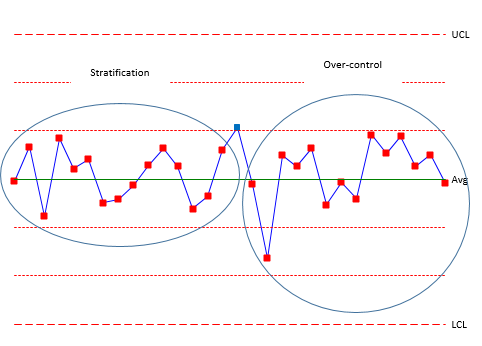
Control Chart Rules And Interpretation Bpi Consulting
Change in the number of defects per unit.
. The c-chart signals whether there has been a. Change in the AOQ b. Sometimes data from a c-chart are also used to describe process capability.
C change in the central tendency of the process output. Change in the percent defective in a sample c. B change in the number of defects per unit.
Cambio en la tendencia central de la salida del proceso. Change in the percent defective in a sample e. Change in the percent defective in a sample e.
48 The c-chart signals whether there has been a. None of the above. The c-chart signals whether there has been a.
Gain or loss in uniformity. Every item in the sample is evaluated for only the number of defects flaws or occurrences etc. The c-chart signals whether there has been a a.
Change in the percent defective in a sample 5. Change in the number of defects per unit c. The c-chart signals whether there has been a change in the percent defective in a sample true or false.
Change in the percent defective in a sample e. D change in the percent defective in a sample. Change in the central tendency of the process output d.
The c-chart signals whether there has been a ttt El gráfico c indica si ha habido un una O gain or loss in uniformity una ganancia o pérdida de uniformidad. Gain or loss in uniformity. Change in the number of defects per unit.
Gain or loss in uniformity b. Signal storage reuse Simulink Coder only if you have a Simulink Coder license Select the following optimization check boxes on the Optimization pane in the Configuration Parameters dialog box. The c-chart signals whether there has been a a.
Change in the central tendency of the process output. Gain or loss in uniformity b. Change in the central tendency of the process output 4.
Change in the percent defective in a sample. Gain or loss in uniformity b. B change in the number of defects per unit.
The local newspaper receives several complaints per day about typographic errors. O change in the number of defects per unit. Change in the central tendency of the process output.
Through the control chart the process will let you know if everything is under control or if there is a problem present. A gain or loss in uniformity. A buy signal is an event or condition selected by a trader or investor as an alert for entering a purchase order for an investment.
The local newspaper receives several complaints per day about typographic. Change in the AOQ b Statistical Process Control SPC moderate 56. Change in the central tendency of the process output d.
So far research and extensive efforts have been made in the area developing better algorithms upgrading existing methodologies improving detection techniques to reduce noise and to acquire accurate EMG signals. Over a seven day period the publisher has received calls from readers reporting the following number of. See the answer See the answer done loading.
Gain or loss in uniformity 2. Gain or loss in uniformity b. Potential problems include large or small shifts upward or downward trends points alternating up or down over time and the presence of mixtures.
The c -chart signals whether there has been a. Change in the percent defective in a sample. Change in the number of defects per unit c.
The c-chart signals whether there has been a a. The x-bar chart tells us whether there has been a a. The c chart is used when the data can only be whole numbers as in counting it is known as attribute or discrete data.
E change in the AOQ. Change in the AOQ. Change in the number of defects per unit c.
However there are issues in how c-charts are often created and applied. Model Advisor checks these parameters. In the C Charts procedure the center line average number of nonconformities may be input directly or it may be estimated from a series of units.
Change in the number of defects per unit c. E change in the AOQ. While Run chart will definitely highlight process stability and special cause existence if any but even control charts can help distinguish between common cause and special cause varaitionTherere rules suggested by western electric and walter shewhart to distinguish between the two causes of variationSome of them to identify special causes are like-1 any.
Change in the central tendency of the process output d. Change in the percent defective in a sample e. The c-chart signals whether there has been a.
A c-chart is an attributes control chart used with data collected in subgroups that are the same size. Few hardware implementations have been done for prosthetic hand control grasp recognition and human-machine interaction. Gain or loss in dispersion b.
C-charts are used in quality control to identify when special-cause or out-of-control conditions occur in time-series count data so that timely corrective actions can be taken to resolve problems. Your answer is correctB. Change in the number of defects in a sample e.
Change in the number of defects per unit 3. Change in the central tendency of the process output d. Change in the central tendency of the process output d.
The c-chart signals whether there has been a 1. A gain or loss in uniformity. If it is estimated from the units the formula for the center line is k D c k i i 1 C Chart Limits The lower and upper control limits for the C chart are calculated using the formulas LCL c m c.
C change in the central tendency of the process output. D change in the percent defective in a sample. Cambio en el número de defectos.
Change in the AOQ B. This problem has been solved. The c chart is used with a constant sample size where you are counting the number of DEFECTS in the sample.
B change in the number of defects per unit. Nonconformities are defects or occurrences found in the sampled subgroup. The c-chart signals whether there has been a a.
Change in the AOQ. Buy signals can be either observed by analyzing chart patterns. Change in the number of defects per unit.
O change in the central tendency of the process output. Change in the AOQ.
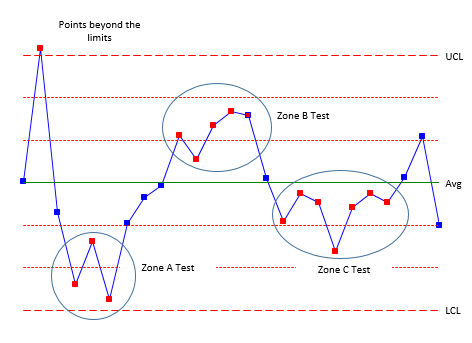
Control Chart Rules And Interpretation Bpi Consulting
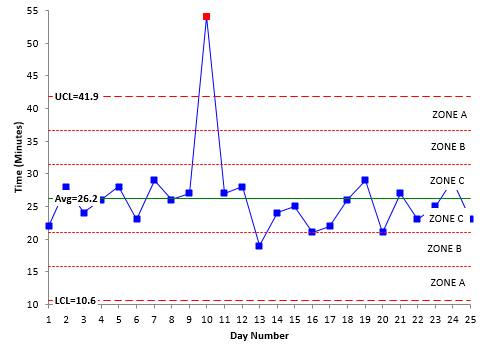
Control Chart Rules And Interpretation Bpi Consulting
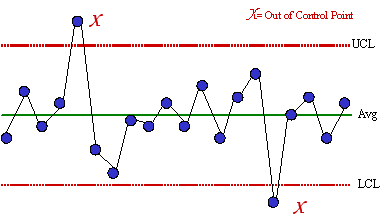
Interpreting Control Charts


Comments
Post a Comment